
When data is the bottleneck for client commitments, the quality of delivery is diminished
Ask an analyst what slows down their projects and they won’t point to the risk model or the audit checklist; they’ll point to the early chaos–finding usable fields, untangling client exports, and fixing what didn’t transfer cleanly. Those hidden hours add up fast, and EASL stabilizes the front end of that work by pulling, organizing, and standardizing client data wherever it lives.
The friction slowing down every professional services engagement
Client data arrives incomplete, inconsistently formatted, or in structures no one anticipated
Teams spend days or weeks repairing logic that doesn’t survive the export process
High-volume datasets overwhelm basic, unscalable tools built for lighter workloads
Partners expect fast turnaround but restrict access to the source system
Reconciliation becomes a recurring task instead of a rare exception
Legacy client platforms must coexist with modern analytics requirements
Prebuilt connectors can’t handle custom objects or unique business rules
Where we work within the professional services ecosystem
Data and Information Services
Research and analytics firms deal with a steady stream of new sources, new formats, and new client expectations. EASL creates a consistent, clean intake layer so teams can publish faster and maintain accuracy as inputs scale and shift.
Turning multi-format, high-volume inputs into analysis-ready datasets
Enabling repeatable ingestion across constantly changing client sources
Aligning internal research environments with external partner data
Reducing the manual cleanup that inflates delivery timelines and storage costs
Consulting, Risk, and Audit Advisory
Recommendations lose authority when the data behind them is shaky. Clients expect precision, but their own systems often tell different stories. EASL normalizes and validates inputs across conflicting sources, giving your team a reliable dataset to work from instead of a puzzle to solve.
Consolidating client exports into a single, auditable dataset
Capturing and preserving lineage across every transformation
Automating data checks that previously required analyst review
Supporting compliance-heavy engagements with error-free data flows
Managed Service Providers
MSPs manage a different tech stack for every client, from Salesforce to legacy ERP systems to fragile custom builds. EASL gives MSPs a standard way to extract and stabilize data so they’re not rebuilding workflows with each new engagement.
Managing interoperability across custom, legacy, and cloud systems
Stabilizing high-frequency operational data streams
Running behind-firewall deployments for sensitive clients
Resolving data errors in-flight rather than after they hit downstream systems

How EASL rewrites the rules for professional services data movement
Professional services work is high-variability by design. EASL handles that variability with a DataDevOps approach that doesn’t break when inputs shift. The platform ingests, validates, transforms, and reconciles data in motion—making the data intake process as predictable as the methodology you run afterward.
Pipelines that absorb
definition, format, and schema changes without rebuilds
Real-time validation
that catches and resolves issues before they reach downstream systems
Behind-firewall deployments
for clients that restrict system access
Continuous error detection
that resolves issues in minutes
A flexible operational layer
that avoids the limitations of connector-driven integrations
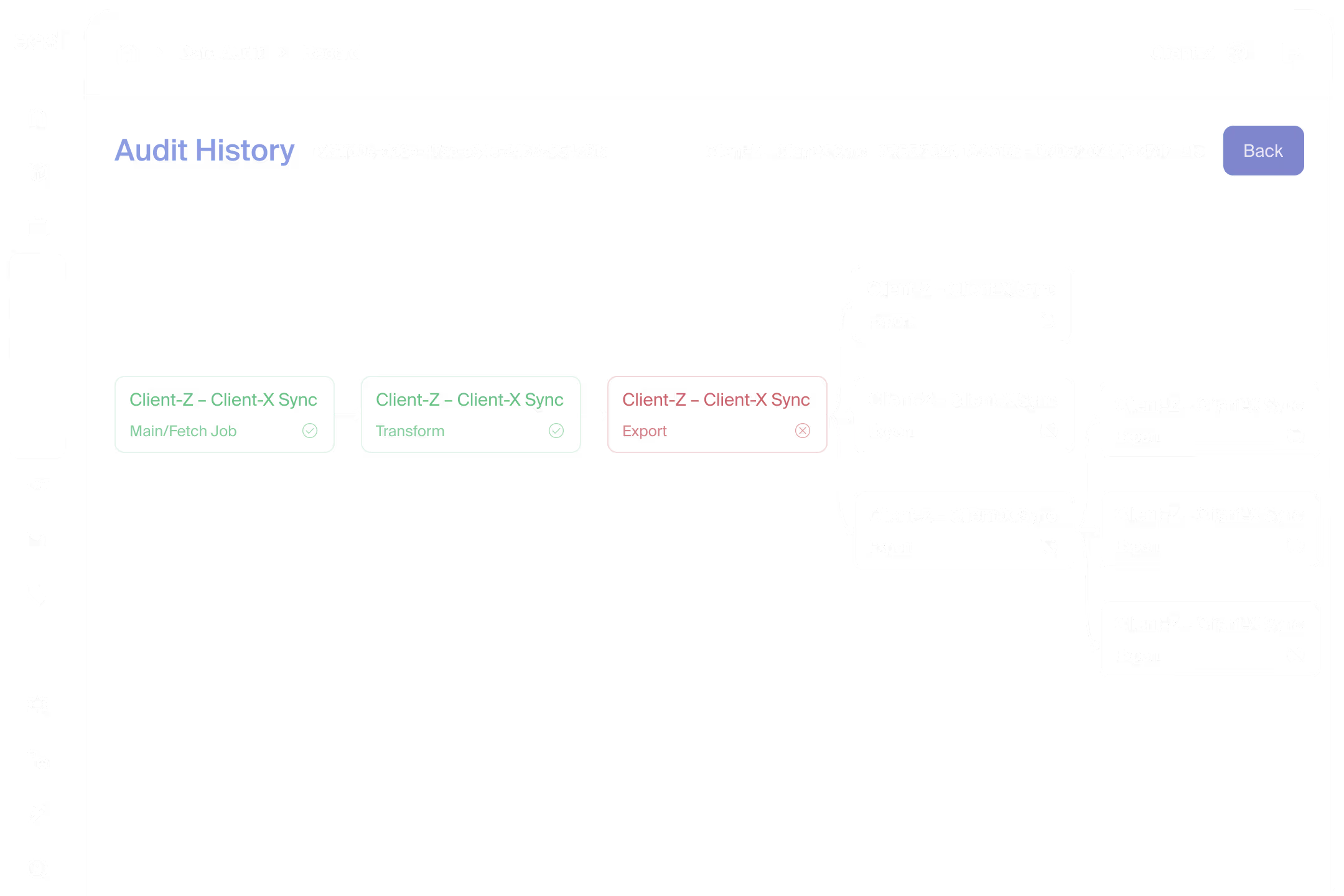
End-to-end lineage for audits,
compliance reviews, and defensibility
A pricing model
that aligns with PS margin without usage spikes or “per-row” surprise
Creating a consistent intake layer for a research and advisory firm
The challenge
Dozens of client datasets, each with different structures and inconsistent logic
Constantly shifting inputs that made every new engagement feel like a ground-up rebuild
Analysts spending hours on manual cleanup and reconciliation before real work could begin
High storage and compute overhead driven by unstandardized exports
What EASL delivered
Standardized intake workflows that ran the same way across all client datasets
Adaptive validation and transformation pipelines that stayed stable as inputs changed
Automated reconciliation that replaced manual error-fixing and review cycles
A repeatable front-end process that protected delivery timelines
Business impact
Faster client onboarding and reduced project slippage
Fewer analyst hours spent on non-billable data prep
More time reallocated to client-facing analysis
See more real-world results in our case study library.
Professional Services Data Movement FAQs
How does EASL help firms that need repeatability across varied client systems?
EASL creates a consistent, normalized intake layer that handles extraction, validation, and transformation across any client system, regardless of format or structure.
Can EASL operate behind client firewalls?
Yes. EASL can be deployed entirely within a client’s environment, using containerized agents that run behind their firewall. Data stays inside their security perimeter while the platform handles extraction, validation, and transformation. This makes it viable for regulated clients or any engagement with strict access controls.
Does EASL reduce rework for analysts and consultants?
Yes. The platform handles the cleanup and reconciliation that typically consumes early project hours, letting teams focus on the insight work clients value.
Does EASL reduce engineering effort?
Yes. Manual validation, brittle transformations, and routine reconciliation work are absorbed by the platform. Engineering teams recover time for higher-value work rather than maintaining pipelines that constantly break.
What kinds of data can EASL process?
EASL works across structured, semi-structured, unstructured, and custom-object data. Whether it comes from a CRM, ERP, SaaS tool, homegrown application, or a set of CSVs, the platform adapts without relying on rigid connectors. This flexibility is especially valuable for firms whose clients rarely use the same systems twice.
How does EASL support audit and risk-oriented engagements?
EASL maintains full lineage across every step in the data’s movement and transformation. That traceability helps teams demonstrate exactly how data was prepared and ensures insights are supported by a defensible, transparent process. It also reduces the back-and-forth that often happens during audit or compliance reviews.
Still got questions? Contact us.
Turn your legacy systems of record into systems of work with EASL.
We're data geeks who love to chat with anyone who appreciates clean infrastructure and issue-free data streams.